
How to write an essay plan
The short answerAn essay plan is a short outline you write before the essay. Underline the command word in the question, write your main argument in one sentence, then plan your main paragraphs with evidence for each, plus a paragraph on the other side. Give about 10% of your words to the introduction, 80% to the main body and 10% to the conclusion.
A plan takes ten minutes. It stops you running out of things to say halfway through, and it stops you drifting away from the question. It works the same way for a timed exam answer, a coursework essay or a university assignment.
What is an essay plan?
An essay plan is a one-page map of your essay. It shows your main argument, the points you'll make, the evidence for each one, the other side, and the order everything goes in.
Nobody marks it. It's for you, so bullet points, abbreviations and arrows are all fine. The only sentence worth writing out in full is your main argument.
How do you write an essay plan?
Work through five stages: read the question, gather your ideas, decide your main argument, plan your paragraphs (including the other side), then split your word count. The Essay Planner takes you through the same parts in order: main argument, introduction, main paragraphs, the other side and conclusion.
What are the 5 stages of essay planning?
There's no official list. Most study skills guides cover the same ground, and we've grouped it into five stages.
-
Read the question
Copy the question out and underline three things: the command word, the topic, and any limits (a date range, a text, a word count).
The command word tells you what kind of answer to give:
- Discuss: look at different sides, then say where you stand.
- Evaluate: weigh up strengths and weaknesses and reach a judgement.
- To what extent: say how far you agree. "Completely", "mostly" and "not much" are all answers.
- Compare: show what's similar and what's different.
- Analyse: break the topic into parts and explain how they work or connect.
-
Gather your ideas
Spend five minutes writing down everything you know that might be useful. A list or a mind map both work. Don't judge anything yet. Then circle the ideas that answer the question best, and note any evidence you already have for them.
-
Decide your main argument
This is the step most people skip. Before you plan any paragraphs, write one sentence that answers the question. For example: "Phone bans are good for learning, but on their own they won't fix students' wellbeing."
If you can't write that sentence yet, think more before you plan. Every paragraph you plan next should back it up.
-
Plan your main paragraphs and the other side
Pick your main points. Each one is a single idea that supports your argument, and each becomes one paragraph. Under each, note your evidence (a quotation, a fact, a study, an example) and one line on why it matters. Strongest first works for most essays.
Then plan the other side: what would someone who disagrees say, and what's your reply? Questions that ask you to discuss, evaluate or say "to what extent" expect this, and it makes any argument more convincing.
-
Split your word count and check
Work out how many words each part gets (see the 10% rule below). Then read the question once more and check every paragraph answers it. Cut any that don't, however interesting they are.
What is the 10% rule for essays?
The 10% rule is a guideline for splitting your word count: about 10% for the introduction, about 10% for the conclusion, and the remaining 80% for the main body. Many UK university study skills guides suggest something close to it, and it works for shorter essays too.
| Word limit | Introduction | Main body | Conclusion |
|---|---|---|---|
| 1,000 | 100 | 800 | 100 |
| 1,500 | 150 | 1,200 | 150 |
| 2,000 | 200 | 1,600 | 200 |
| 2,500 | 250 | 2,000 | 250 |
| 3,000 | 300 | 2,400 | 300 |
It's a starting point. If your teacher, lecturer, mark scheme or module handbook says something different, follow that. Dissertations and reports have their own structure, with sections such as a literature review and method.
An essay plan example
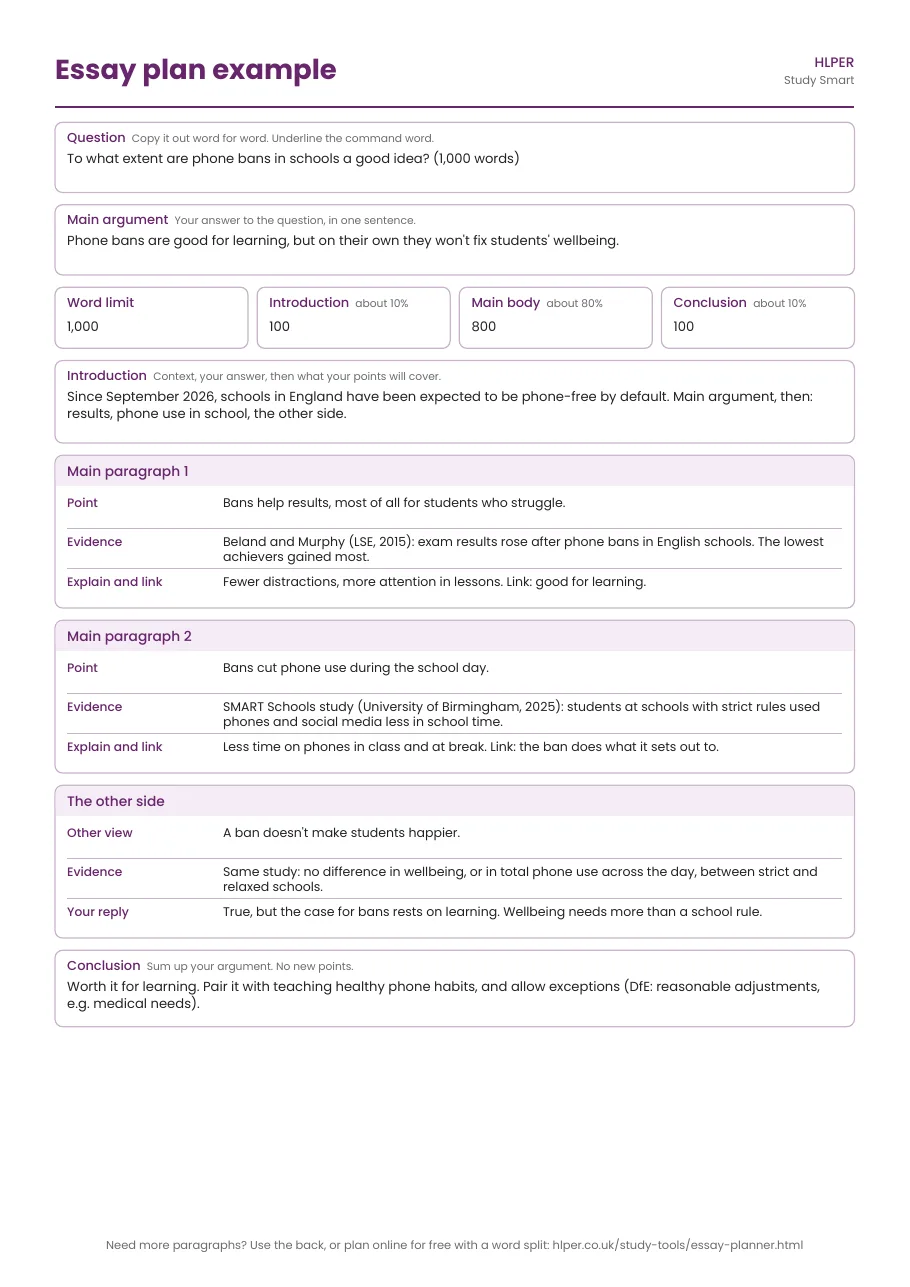
This finished plan is for a 1,000-word essay. It follows the same parts as the Essay Planner. The evidence is real, and the sources are listed at the end of this guide.
- Question
- To what extent are phone bans in schools a good idea? (1,000 words)
- Main argument
- Phone bans are good for learning, but on their own they won't fix students' wellbeing.
- Word split
-
1,000word limit100introduction800two main paragraphs of about 275, the other side about 250100conclusion
- Introduction
- Since September 2026, schools in England have been expected to be phone-free by default. State the main argument, then say what the essay covers: results, phone use in school, the other side.
- Main paragraph 1: Bans help results, most of all for students who struggle
- Evidence: Beland and Murphy (LSE, 2015) found exam results rose after schools in England banned phones. The lowest achievers gained most.
- Explain and link: fewer distractions mean more attention in lessons, so bans are good for learning.
- Main paragraph 2: Bans cut phone use during the school day
- Evidence: the SMART Schools study (University of Birmingham, 2025) looked at 1,227 students in 30 schools. Students at schools with strict rules used their phones and social media less during school time.
- Explain and link: less time on phones in lessons and at break. The ban does what it sets out to do.
- The other side: a ban doesn't make students happier
- Evidence: the same study found no difference in wellbeing between schools with strict and relaxed rules, and no difference in total phone use across the day.
- Reply: true, but the case for bans rests on learning. Wellbeing needs more than a school rule.
- Conclusion
- Worth it for learning. Pair it with teaching healthy phone habits, and allow exceptions: the Department for Education's guidance says schools must still make reasonable adjustments, for example for pupils with medical needs.
Each part of the plan is a line or two, not a paragraph. When you write the essay, each main paragraph grows into a full PEEL paragraph: Point, Evidence, Explain, Link. The PEEL Paragraph Builder helps you do that one part at a time, with examples and sentence starters.
How to plan for exams, coursework and longer essays
The five stages work for any essay. What changes is how much time you have and how much reading sits behind each point.
Timed exam essays
Whether it's an English answer at GCSE or National 5, a Higher or A level history essay, or a university exam, the plan has to be quick. For a 45-minute essay, aim for about five minutes. Write your main argument and three or four bullet points, each with a quotation or example, plus one for the other side. Exam boards usually ask you to cross through rough work, so draw a line through your plan when you've finished.
If marks are split across assessment objectives (knowledge, applying it, analysing or evaluating it), check the mark scheme and make sure your plan gives each one something to earn marks with.
Coursework and assignments
With more time, you can plan properly. Start with the brief and the marking criteria, then gather your evidence. Write your main argument before you plan paragraphs, and keep notes of where every piece of evidence came from. Use the 10% rule to stop one section eating your word count.
Longer essays and university work
For essays of 2,000 words or more, plan four to six main paragraphs. Read with your question in mind, and note the author, year and page number beside each piece of evidence as you go. It saves hours when you write your references. If your course gives guidance notes for each assignment, as the Open University does, plan to them.
With a free HLPER account, you can save your plan to an assessment and keep your notes and references beside it.
Common essay planning mistakes
- No main argument. A plan full of points but no clear answer leads to an essay that lists things without arguing anything.
- Paragraphs that don't link back. If you can't say how a point supports your argument, cut it.
- Leaving out the other side. An argument that ignores the obvious objection is easy to knock down. Plan your reply to it from the start.
- Planning for too long. A plan should take ten to fifteen minutes for coursework and about five in an exam. If you're writing full paragraphs, you've started the essay.
Questions students ask
How long should an essay plan be?
For coursework, half a page to a page is plenty. In an exam, a few lines of bullet points will do. If your plan is turning into the essay, stop and start writing.
Should I write my essay plan in full sentences?
Only your main argument. Write everything else as short bullet points. Full sentences slow you down and make the plan harder to scan.
Is it worth planning in an exam?
Yes. A few minutes of planning keeps you answering the question you were asked. For a 45-minute essay, about five minutes is a good target.
Does the same plan work at school and university?
Yes. The steps stay the same. What changes is the length, how much reading sits behind each point, and how carefully you record your sources.
Can I change my plan while I'm writing?
Yes. If a better point turns up, use it. Then check your introduction and conclusion still match what you ended up arguing.
Is there a free essay plan template?
Yes. HLPER's Essay Planner is free and needs no account. It also works out a word split for you. There is a printable PDF and Word version too.
Sources for the example
- Beland, L.-P. and Murphy, R. (2015) Ill communication: technology, distraction and student performance. Centre for Economic Performance, LSE.
- University of Birmingham SMART Schools team (2025) School phone policies and their association with mental wellbeing, phone use, and social media use (SMART Schools). The Lancet Regional Health: Europe.
- Department for Education (2026) Mobile phones in schools. Statutory guidance for schools in England.