
Free essay plan template
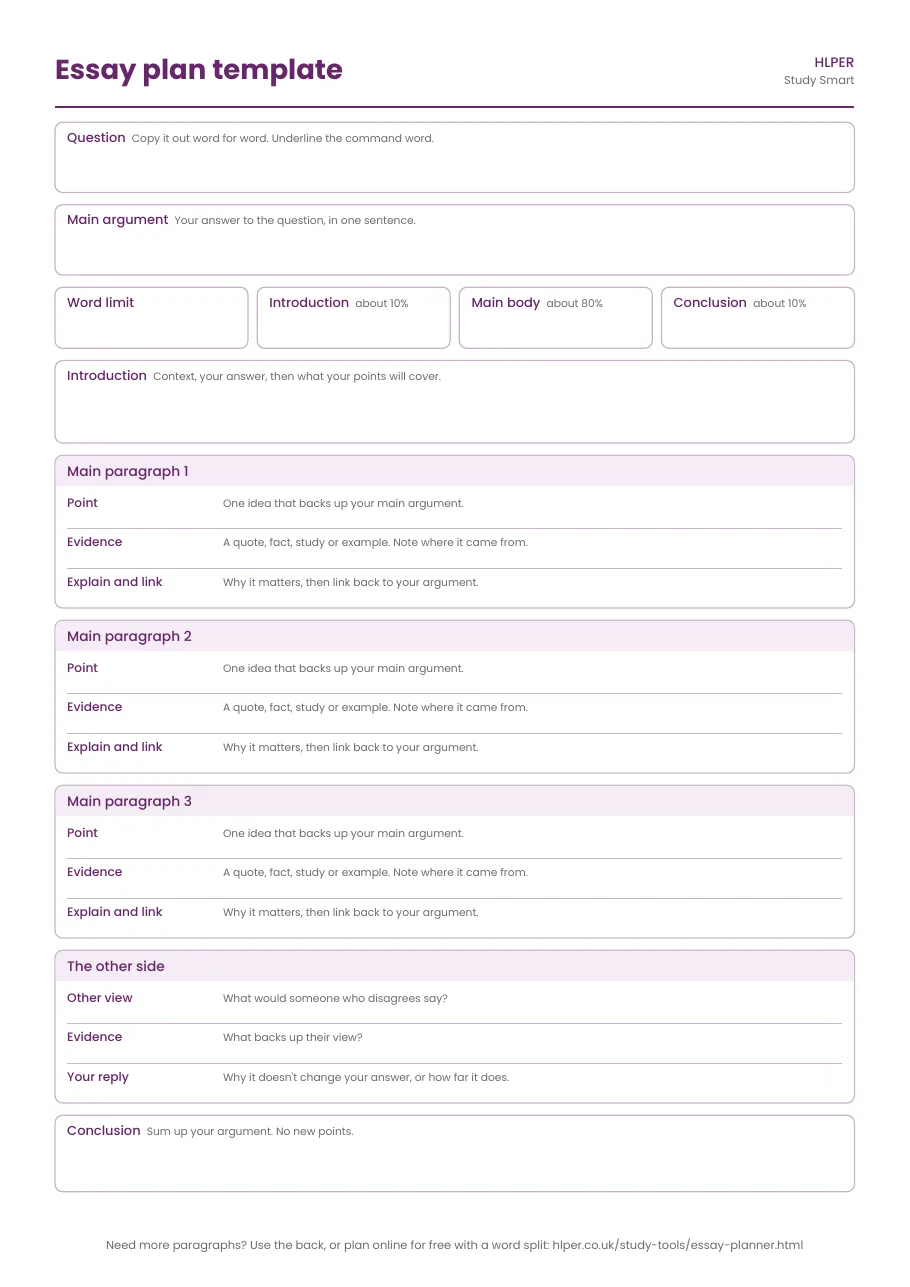
The short answerA good essay plan template has seven parts: the question, your main argument in one sentence, a word split, an introduction, your main paragraphs with evidence, the other side, and a conclusion. Fill it in online with HLPER's free Essay Planner, or print the one-page PDF or Word version below.
Use the essay plan template online
The Essay Planner is the same template as a step-by-step tool. It takes you through your main argument, introduction, main paragraphs, the other side and conclusion in turn, with examples and tips at each step.
- Word split: type in your word limit and it suggests how many words each part should get.
- No sign-up: it works straight away and keeps your work in your browser.
- Copy when done: copy your finished plan into your notes or essay document.
- Save to an assessment: with a free HLPER account, you can save the plan to one of your assessments and come back to it on any device.
Download a printable essay plan template
Prefer paper? The printable version fits on one side of A4, with room for three main paragraphs and the other side.
The PDF is best for printing. The Word file lets you type into the boxes and add more paragraphs. To use it in Google Docs, upload the Word file to Google Drive and open it with Google Docs.
Teachers and lecturers are welcome to print copies for a class.
What goes in each box
Question
Copy the question out word for word, then underline the command word (discuss, evaluate, to what extent, compare, analyse). It tells you what kind of answer the marker wants.
Main argument
Your answer to the question in one sentence. If you can't write it yet, you're not ready to plan your paragraphs. Everything else on the page should back it up.
Word split
Start with about 10% for the introduction, 80% for the main body and 10% for the conclusion. For a 1,500-word essay, that's 150, 1,200 and 150. Share the main body between your paragraphs, including the other side.
Introduction
Three notes: a line of context, your main argument, and what the essay will cover. Don't write the introduction out yet.
Main paragraphs
Each main paragraph gets three lines:
- Point: one idea that backs up your main argument.
- Evidence: a quotation, fact, study or example, with where it came from.
- Explain and link: why the evidence matters, and how it supports your argument.
That's the PEEL shape (Point, Evidence, Explain, Link). When you write the essay, the PEEL Paragraph Builder turns each one into a full paragraph, with examples and sentence starters.
The other side
What would someone who disagrees say, what backs up their view, and what's your reply? Questions that ask you to discuss, evaluate or say "to what extent" expect this. Answering an objection makes your own argument stronger.
Conclusion
Restate your main argument and pull your paragraphs together. No new points here.
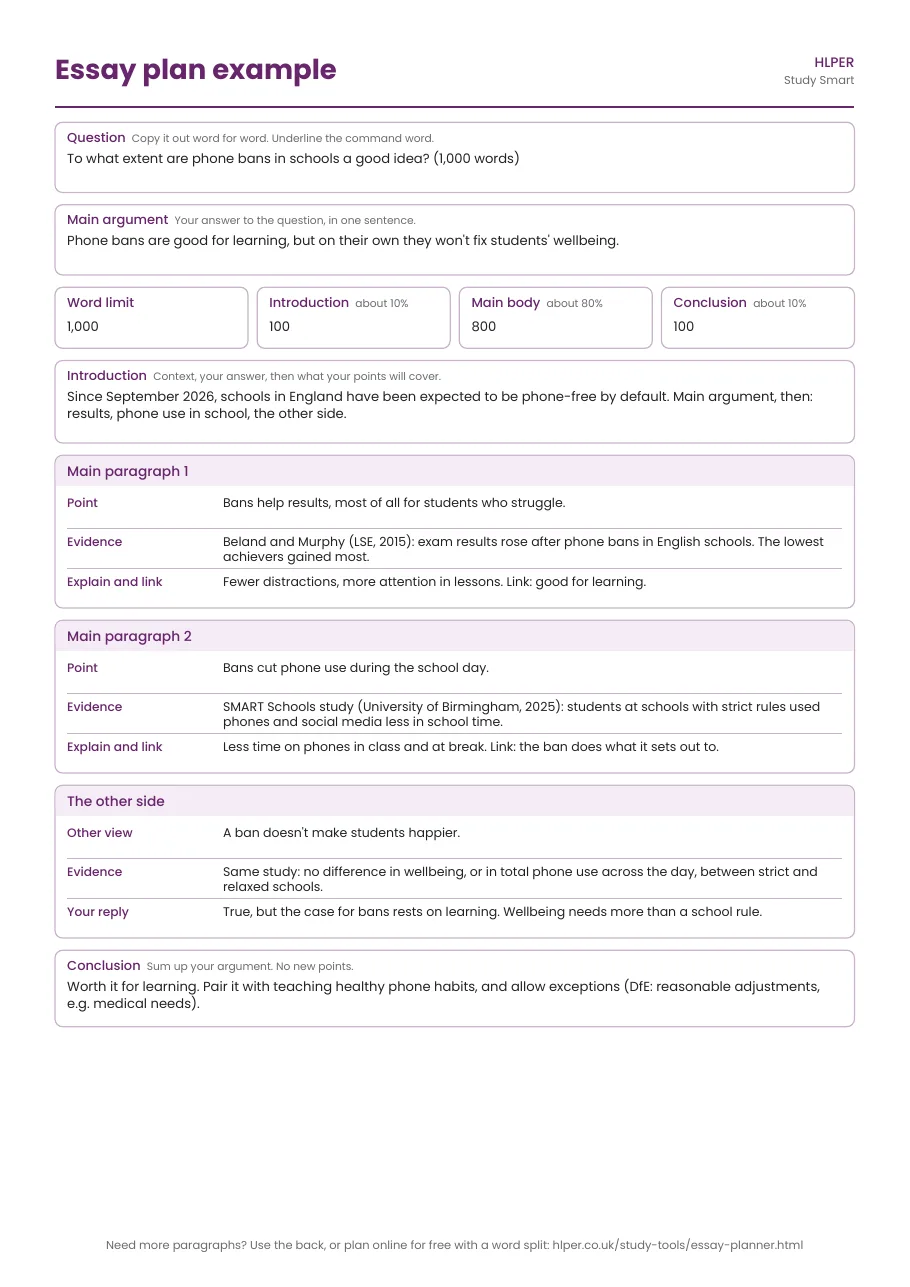
Essay plan sample
This is the template filled in for a 1,000-word essay on phone bans in schools. The evidence is real. The full walkthrough and sources are in our guide to writing an essay plan.
Adapting the template for exams, coursework and longer essays
The same template works for any essay, with small changes.
Timed exam essays
You won't have a printed template in an exam, whether it's a GCSE, National 5, Higher, A level or university paper. Learn its shape and jot it down in a few lines:
- Q: underline the command word
- A: your main argument in one sentence
- 1, 2, 3: your main points, each with a quotation or example
- O: the other side and your reply
- C: one line for your conclusion
That takes about five minutes. Cross it through when you've finished, as exam boards usually ask for rough work.
Coursework and assignments
Use the full template. If your marks are split across assessment objectives or marking criteria, note beside each paragraph which one it earns marks for, so nothing gets missed.
Longer essays and university work
Use the Word version so you can add rows. Essays of 2,000 words or more often need four to six main paragraphs. Add the author, year and page number beside each piece of evidence as you plan, and keep the marking criteria open beside the template.
Questions students ask
Is the essay plan template free?
Yes. The online Essay Planner, the PDF and the Word file are all free. You can print as many copies as you like.
Do I need an account?
No. You can use the online Essay Planner and download the template without signing up. An account only matters if you want to save your plan to an assessment.
Where is my work saved?
Without an account, the online Essay Planner keeps your work in your browser on that device. If you clear your browser data or switch device, it won't be there. If you're logged in, you can save it to one of your assessment plans.
Can I use the template in Google Docs?
Yes. Download the Word file, upload it to Google Drive, then open it with Google Docs.
How many paragraphs should an essay plan have?
For most essays, two to four main paragraphs plus one on the other side. A timed exam answer or a 1,000-word essay usually needs two or three. Essays of 2,000 words or more often need four to six.